Short answer: Hard water damages combi boilers by coating the small heat exchanger that heats your tap water. In Bristol, where Bristol Water classes all supply as moderately hard to very hard, that is a real risk. Building guidance expects scale treatment on combi feeds above 200 ppm. A scale reducer and an annual service cut the damage.
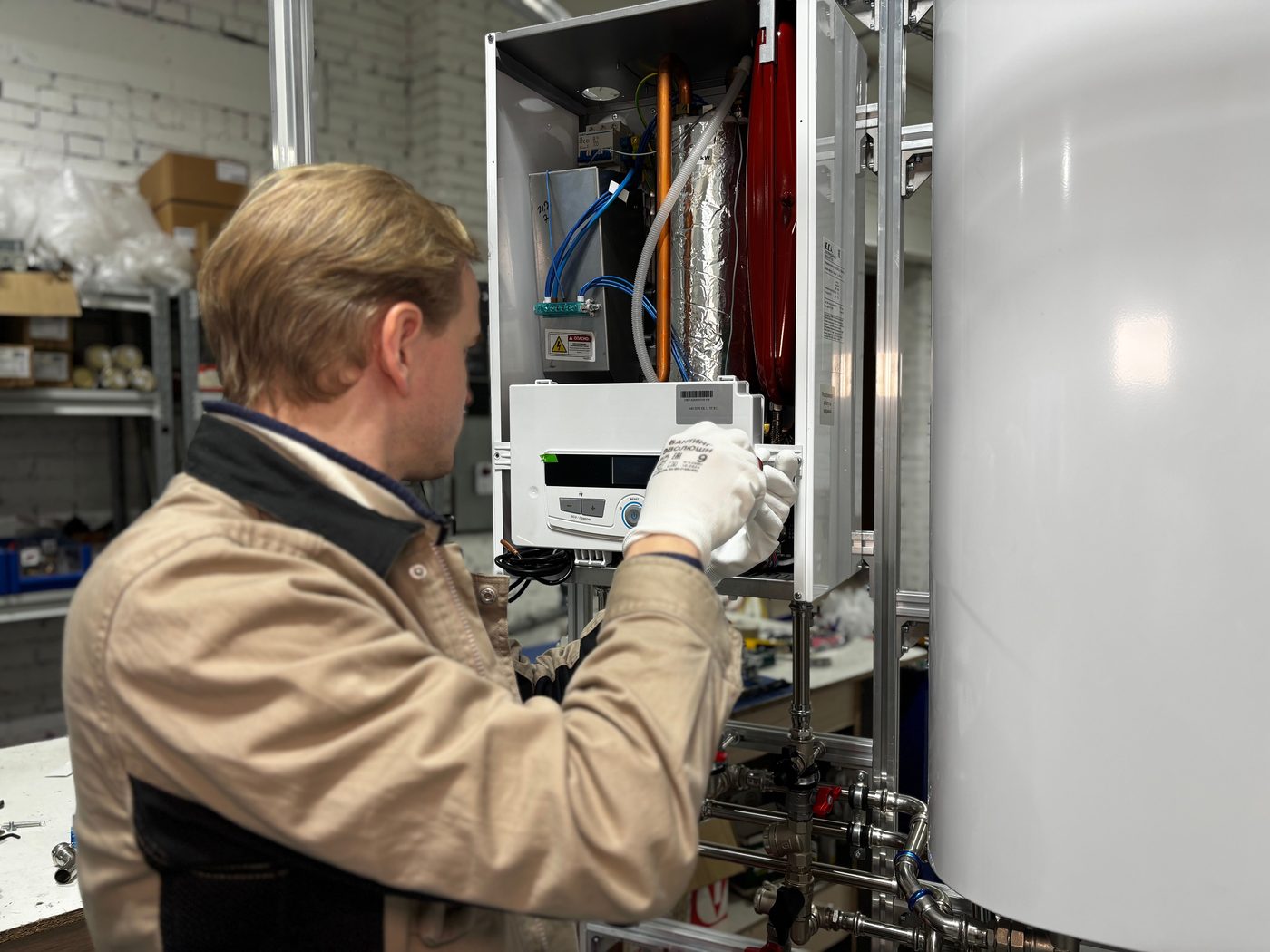
Combi boilers are the most common boiler in Bristol homes. They are compact, they heat water on demand, and they suit flats and terraces with no room for a cylinder. They also have a weak spot in hard water areas, and Bristol is one of them.
This guide explains why hard water matters for a combi, the signs that scale is building up, and the steps that protect the boiler.
Why combis suffer in hard water
A combi heats your tap water the moment you open a hot tap. It does this by passing mains water through a small plate heat exchanger, a stack of thin plates with narrow gaps between them. Hot water from the heating side runs on one side of the plates. Your tap water runs on the other.
When hard water is heated, calcium and magnesium drop out as scale. In a kettle that scale sits on the bottom. In a plate heat exchanger it coats the plates and narrows the gaps. Less water gets through, and what does get through heats unevenly.
Bristol Water says all the water in its supply area is moderately hard to very hard. So a combi in Clifton, Kingswood or Keynsham faces the same issue. Only the speed differs, depending on your exact hardness and how much hot water you use.
Signs of scale in a combi
| What you notice | What may be happening |
|---|---|
| Hot water swings between hot and cold | Plates partly blocked, flow uneven |
| Hot water flow is weaker than it was | Scale narrowing the passages |
| Boiler bangs or kettles when you run a tap | Water boiling in a scaled spot |
| Heating works but hot water is poor | Fault on the domestic hot water side |
| Fault codes about overheating on hot water | Sensor reading high temperatures from restricted flow |
These signs can also come from other faults, such as a diverter valve or a flow sensor. A proper diagnosis matters before parts are changed. Our boiler repair page explains how we test and diagnose.
What the building guidance says
This is not just advice from plumbers. The government’s Domestic Building Services Compliance Guide, which supports the Building Regulations in England, says that where water hardness is above 200 ppm, provision should be made to treat the feed water to water heaters and the hot water circuit of combination boilers. The aim is to slow the rate at which scale builds up.
On Bristol Water’s own scale, 201 to 300 mg/l counts as hard and above 300 as very hard. If your postcode reads above 200, the guidance applies to you. You can check yours with the Bristol Water postcode checker. Boiler makers also tend to make scale protection a condition of their warranty in hard water areas, so it is worth checking your paperwork.
Ways to protect a combi
Inline scale reducer. A small unit on the cold feed into the boiler. Common types use polyphosphate, which Bristol Water describes as combining with calcium and magnesium so scale does not form when the water is heated. Some need a cartridge change. Others are magnetic or electrolytic.
Whole house softener. Removes the hardness before it reaches the boiler, along with every tap and shower. More expensive and needs space and salt, but it protects everything. See our guide on whether a water softener is worth it in Bristol.
Sensible hot water temperature. A combi does not store water, so a slightly lower hot water setting can reduce scale without the legionella concern that applies to stored water in a cylinder.
Annual service. A Gas Safe registered engineer checks the boiler is burning safely and can spot the early signs of scale before they turn into a breakdown.
System filter and inhibitor. These protect the heating side from sludge rather than scale, but they are part of looking after the whole boiler.
Repair or replace a scaled combi
If a combi is badly scaled, the options are:
- Descale the plate heat exchanger. Sometimes possible, and worth trying on a newer boiler.
- Replace the plate heat exchanger. A common repair on many models. Parts availability depends on the make and age.
- Replace the boiler. Makes sense if the boiler is old, has other faults, or parts are no longer made.
Whatever the choice, fitting scale protection afterwards is the step that stops the same thing happening again. If you are weighing up a new boiler, our new boiler page explains the choices.
A note on gas safety
Any work on the gas side of a boiler must be done by a Gas Safe registered engineer. Ask to see their Gas Safe ID card and check it on the Gas Safe Register. The card shows which types of gas work they are qualified to do. Fitting a scale reducer on the cold feed is water work, but it is usually done during a service or install by the same engineer.
Typical Bristol situations
In the tight Victorian terraces of Bedminster and Southville, combis are often in the kitchen or a small back bedroom, and they run hard because the whole house relies on them. In newer homes in Bradley Stoke, many original systems have been swapped for combis over the years, and some of those were fitted without any scale protection. Both are worth checking at the next service.
The short version
Bristol’s hard water and combi boilers do not mix well without help. Check that your combi has scale protection on the cold feed, get it serviced every year, and act early if your hot water starts to swing or weaken.
Quick questions
Does hard water damage combi boilers?
Yes. A combi heats tap water instantly through a small plate heat exchanger. Calcium and magnesium in hard water drop out as scale when heated, and that narrows the passages over time.
Do I need a scale reducer on my combi in Bristol?
Most Bristol installs should have one. Building guidance says feed water to combi hot water circuits should be treated where hardness is above 200 ppm, and boiler makers often require it for the warranty.
Can a scaled combi be repaired?
Often, yes. The plate heat exchanger can sometimes be descaled or replaced on its own. Whether that is worth it depends on the boiler's age and condition.
Should I turn my combi temperature down?
On a combi, setting the hot water a little lower can reduce scale, because it does not store water. This is different from a hot water cylinder, which should store water at 60 C.
Last updated 23 October 2026. Written for homes in Bristol. Rules can change, so check the linked sources for the latest position.